In urban development across Africa and other emerging economies, there is a recurring assumption that infrastructure delivery equals city development.
Roads are built. Bridges are completed. Housing estates are commissioned. Utilities are installed.
On paper, progress is recorded.
But in reality, many of these cities do not function as intended after delivery.
This reveals a critical truth in urban development:
Infrastructure alone does not create cities that work.
Infrastructure provides physical structure. It does not guarantee functionality, sustainability, or long-term performance.
A city is not defined by what is built. It is defined by whether what is built continues to work over time.
This distinction is central to understanding why many urban development projects underperform after completion.
The Core Problem in Urban Development
Most urban development frameworks are built around delivery milestones.
Once infrastructure is completed and commissioned, the project is considered successful.
However, this approach creates a gap between construction and actual urban performance.
In many cases, the following patterns emerge after delivery:
• Maintenance systems are weak or inconsistent
• Infrastructure begins to deteriorate earlier than expected
• Communities do not fully integrate into planned systems
• Economic activity does not scale in line with projections
• Public systems operate below design capacity
The result is a city that exists physically but does not function effectively.
This is the central issue in many developing urban environments: delivery is prioritised over long-term functionality.
Why Infrastructure Alone Is Not Enough
Infrastructure is only one component of a functioning city system.
For a city to work effectively, several non-physical systems must operate alongside infrastructure.
1. Human Capability
Cities are operated by people, not by infrastructure.
Engineers, urban planners, technicians, administrators, service providers, entrepreneurs, and residents all influence how systems perform in practice.
Where there is a shortage of capability, infrastructure begins to degrade regardless of design quality.
This is why identical infrastructure projects can produce very different outcomes in different cities.
2. Leadership and Governance Systems
Urban infrastructure requires continuous management, not one-time delivery.
Leadership determines how systems are maintained, how resources are prioritised, how policies evolve, and how accountability is enforced.
Where governance structures are weak, infrastructure becomes reactive instead of proactively managed.
Over time, this reduces efficiency and system reliability.
3. Behaviour and Urban Culture
Cities function based on how people interact with systems.
Transport networks, waste management systems, public utilities, and shared infrastructure all depend on user behaviour.
When public behaviour is not aligned with system design, inefficiencies emerge that reduce overall performance.
Urban development outcomes are therefore influenced not only by engineering, but also by culture and compliance.
4. Economic Activation
Infrastructure only becomes valuable when it supports sustained economic activity.
Cities function effectively when infrastructure enables:
• production and commerce
• mobility and trade
• access to opportunity
• efficient resource flow
Without economic activation, infrastructure becomes underutilised capital rather than productive urban systems.
The African Urban Development Gap
Across many African cities, the primary challenge is not lack of investment.
It is the imbalance between physical infrastructure development and system capability development.
In many cases:
• Infrastructure is delivered faster than operational systems are built
• Cities are constructed faster than governance capacity matures
• Urban planning advances faster than behavioural and institutional alignment
This creates a structural gap between physical development and functional performance.
The result is not failure of infrastructure, but failure of system integration.
This is one of the most important issues shaping the future of urban development across the continent.
Rethinking What Smart Cities Mean
The term “smart city” is often associated with technology adoption, automation, sensors, and digital platforms.
However, technology alone does not create smart cities.
A smart city is defined by system alignment, not digital presence.
A functioning smart city requires alignment across four layers:
• Infrastructure that is properly designed and delivered
• Human capability to operate and maintain systems
• Governance structures that ensure continuity and accountability
• Data systems that support informed decision-making
When these elements are not aligned, technology becomes an additional layer rather than a functional enabler.
The Real Question in Urban Development
Most urban development conversations focus on one question:
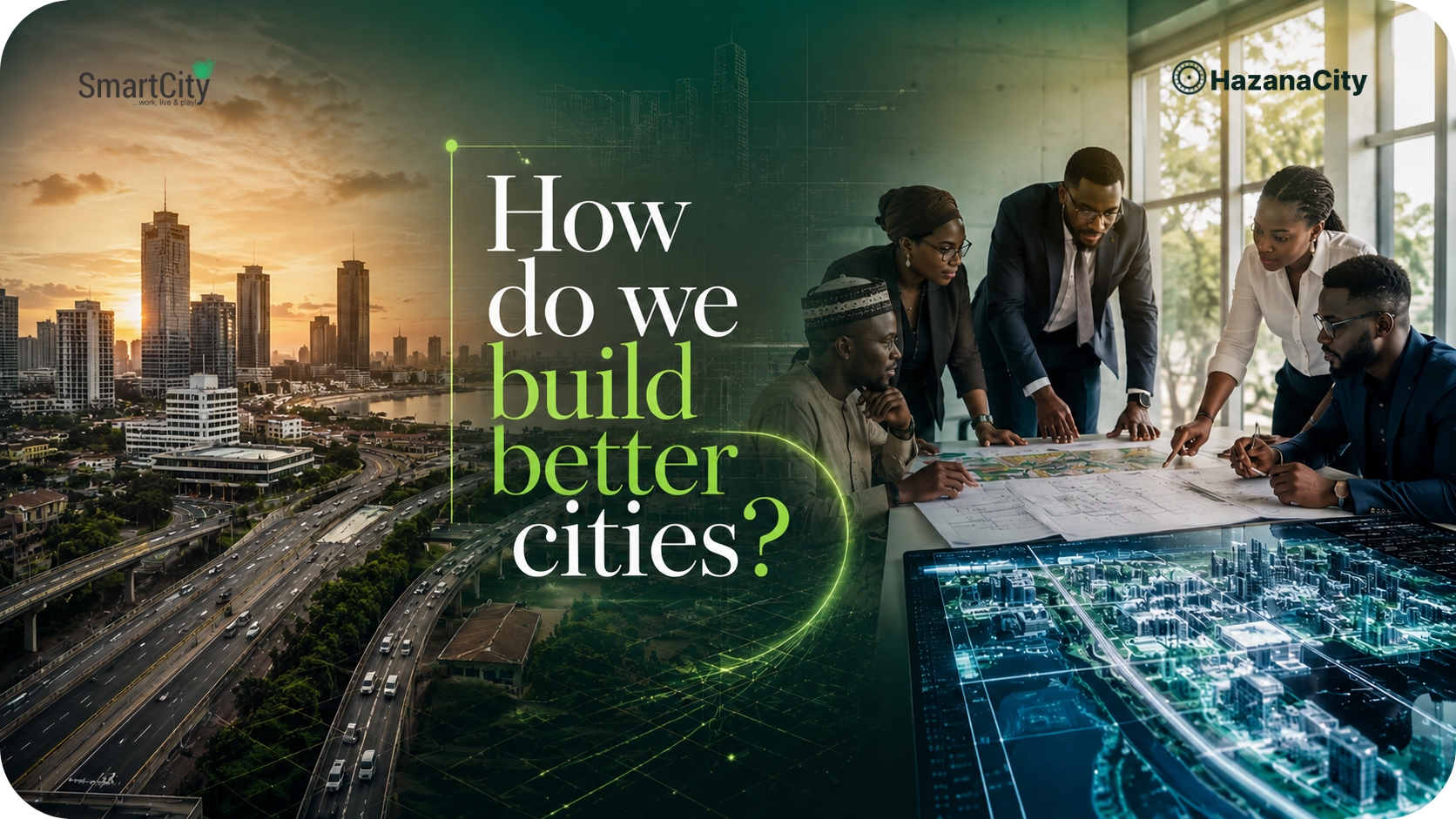
“How do we build better cities?”
However, a more important and often overlooked question is:
“Do we have the systems, leadership, and human capacity required to make the cities we are building actually work?”
This shift changes the entire way we think about development. It moves the focus from construction to sustainability, from delivery to performance, and from infrastructure alone to systems thinking.
The real measure of a city is not when it is completed. It is how well it continues to function long after completion.
A Shift in Urban Development Thinking
The future of urban development will not be determined by the volume of infrastructure delivered.
It will be determined by the strength of the systems that sustain that infrastructure over time.
Cities that perform consistently are not only built. They are managed, maintained, and continuously improved.
This requires a shift in approach:
From viewing cities as projects with completion timelines To viewing cities as living systems that require continuous coordination and capacity
Living systems depend on more than physical assets. They depend on capability. They depend on governance. They depend on people.
Continuing the Conversation
These ideas were explored during a session of SmartCity Engage, where stakeholders discussed urban development, leadership, and the future of sustainable city-building in Africa.
Watch the full session: https://drive.google.com/file/d/16ikISYOQzHXCMyXD5jEJgudXbEnd9tje/view?usp=drivesdkusp=drive_link
Register for upcoming editions of SmartCity Engage:
https://docs.google.com/forms/d/e/1FAIpQLSeAEERLiDeexwiUtnVnXi0bNIAwKnIM2hI7S_duuWlRmqT6hg/viewform?usp=header
The effectiveness of a city is not determined at the point of commissioning.
It is determined by what happens long after delivery.
That is the real test of urban development.