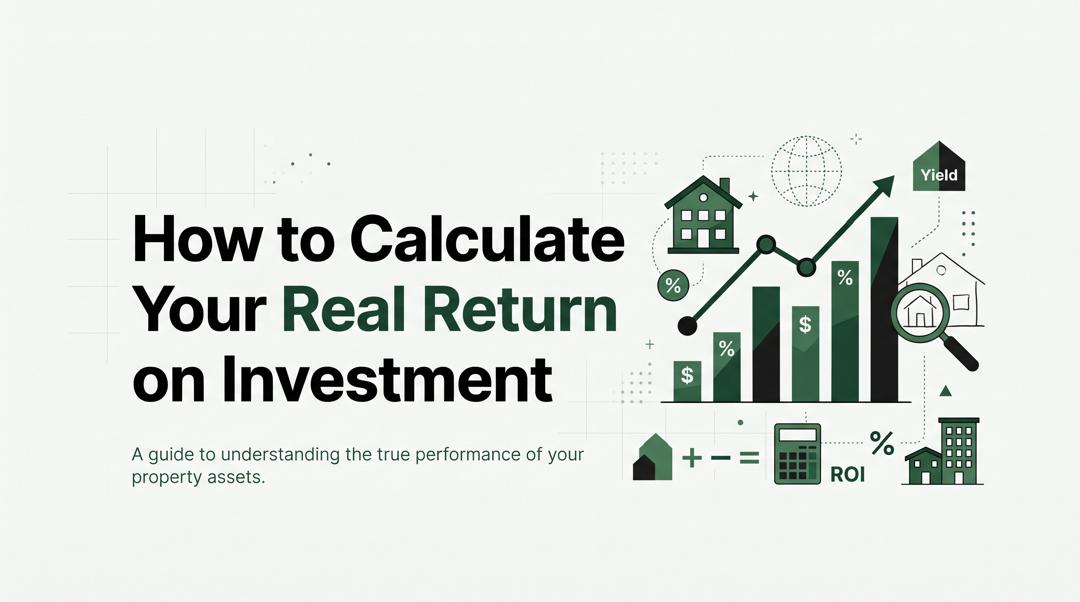
Before You Invest in Property: How to Calculate Your Real Return on Investment
A property may increase in value over time, but how much of that increase translates into
actual profit? And how do you determine whether the investment was worth the money
committed to it?
These are questions worth asking before putting your money into any property.
In real estate, profitability is often measured by comparing the purchase price with the
eventual selling price. But that comparison alone can be misleading. Acquisition costs,
documentation, transaction expenses and the time it takes to sell all influence the actual
return on an investment.
Understanding these factors gives you a clearer picture of what a property could deliver
financially and helps you make decisions based on more than expected appreciation.
Let’s look at how this works.
- Understanding Return on Investment (ROI)
Return on Investment, commonly known as ROI, measures the profit generated from an
investment relative to the amount invested.
In real estate, it helps you understand how much you have gained compared with what you
spent to acquire a property.
The formula is straightforward:
ROI = (Net Profit ÷ Total Investment Cost) × 100
The important thing to remember is that ROI is based on your actual profit after relevant
expenses, not simply the difference between your purchase and selling prices.
Let’s put this into perspective. - Calculate Your Actual Profit
Imagine you purchase a plot of land for ₦10 million.
You spend another ₦500,000 on acquisition and documentation, bringing your total initial
investment to ₦10.5 million.
Three years later, you sell the property for ₦15 million, with another ₦500,000 spent on
completing the sale.
To determine your actual profit, subtract all these costs from the selling price:
₦15,000,000 − ₦10,000,000 − ₦500,000 − ₦500,000 = ₦4,000,000.
Your actual profit is therefore ₦4 million.
If you had simply subtracted the purchase price from the selling price, you would have
arrived at ₦5 million, overstating your profit by ₦1 million.
This is why calculating the full cost of acquiring and selling a property is essential. The
expenses involved can make a significant difference to your final return. - Now, Calculate Your ROI
With your actual profit established at ₦4 million and your initial investment at ₦10.5 million,
you can now calculate your return.
ROI = (₦4,000,000 ÷ ₦10,500,000) × 100
ROI = 38.1%
This means your investment generated a return of approximately 38.1% on the initial amount
committed.
In practical terms, for every ₦1 invested, you earned approximately 38 kobo in profit.
That gives you a clearer measure of how your money performed. But there is another factor
to consider: how long did it take to achieve that return? - Why the Time Factor Matters
Consider two investors who each commit ₦10.5 million to separate property investments.
Both eventually make a 38.1% return.
The difference is that Investor A achieves this in two years, while Investor B takes six years.
Although the total returns are identical, the investments have performed differently over time.
Investor A has realised the return much sooner and can potentially reinvest the proceeds in
another opportunity. Investor B has had their capital tied up for a considerably longer period.
This is why the holding period matters. A good investment is not just about how much you
stand to make, but also how long your money may remain committed before you can access
the proceeds.
When evaluating a property, consider both its potential return and the realistic timeframe for
achieving it. Property sales can take longer than expected, and projected returns are never
guaranteed. - Appreciation Is Not the Same as Profit
Property appreciation refers to an increase in the market value of a property over time.
For example, if you purchase a plot for ₦10 million and its estimated market value rises to
₦14 million after two years, it has appreciated by ₦4 million, representing a 40% increase.
That is encouraging, but it does not necessarily mean you have made ₦4 million in actual
profit.
There is a difference between what a property is estimated to be worth and what a buyer is
willing to pay for it.
The eventual selling price depends on factors such as buyer demand, location, accessibility,
prevailing market conditions, title documentation and competing properties.
You may also incur additional expenses before completing the sale.
Until a transaction is concluded, the increase in value remains an unrealised gain.
This is why investors should look beyond appreciation figures and consider how easily a
property can attract buyers and be converted into cash. - What If You Invest in Property for Rental Income?
Not every property investment is about buying and selling. Some investors acquire residential
or commercial properties to generate recurring rental income.
In this case, one important measure is rental yield.
Suppose you purchase an apartment for ₦50 million and earn ₦4 million in annual rent.
Your gross rental yield is calculated as follows:
Gross Rental Yield = (Annual Rental Income ÷ Property Value) × 100
₦4,000,000 ÷ ₦50,000,000 × 100 = 8%
This means the property generates annual rental income equivalent to 8% of its value.
However, rental income is not the same as rental profit. You still need to account for
expenses such as repairs, maintenance and property management.
If these expenses amount to ₦1 million annually, your remaining rental income is ₦3 million.
Your net rental yield becomes:
Net Rental Yield = (Annual Rental Income − Operating Expenses) ÷ Property Value ×
100
₦3,000,000 ÷ ₦50,000,000 × 100 = 6%
This gives you a more realistic picture of the property’s income-generating performance.
Other factors, including financing costs, taxes and periods without tenants, may further affect
your actual return.
Before You Invest, Ask Yourself These Five Questions
Beyond the calculations, a sound property investment decision requires you to examine the
property, its location and its potential market.
Before committing your money, consider:
- What is the total cost?
Look beyond the advertised purchase price. Account for documentation, legal fees, statutory
charges and other acquisition or development expenses. - What supports the property’s potential for appreciation?
Consider its location, accessibility, infrastructure, economic activity and evidence of market
demand. An area’s description as an emerging investment destination is not, on its own, proof
of future value growth. - Who might buy or occupy this property in the future?
Consider the potential market for the property, whether homeowners, tenants, businesses or
other investors. Understanding who the eventual buyer or occupant might be helps you assess
its commercial appeal. - How long can I afford to keep my money invested?
Property is not always easy to sell quickly. Consider whether you can accommodate a longer
holding period without putting pressure on your finances. - Have I independently verified the property’s legal status?
Confirm ownership, title documentation and any relevant restrictions or disputes. Engage
qualified professionals to conduct the necessary checks before completing a transaction.
These questions will not eliminate investment risks, but they can help you evaluate
opportunities more carefully.
The Bottom Line
A property’s investment potential goes beyond its purchase price or how much its value is
expected to increase.
What matters is understanding the full cost of acquiring it, the returns it can realistically
generate and the time required to realise those returns.
Whether you are acquiring property for future appreciation or rental income, understanding
these fundamentals puts you in a better position to compare opportunities and make informed
financial decisions.
Disclaimer: This article is intended for general educational purposes only and does not
constitute financial, legal or investment advice. Property values, rental income and
investment returns are not guaranteed. Actual outcomes depend on market conditions,
transaction costs and other factors. Prospective investors should conduct independent due
diligence and seek appropriate professional advice before making investment decisions.
About SmartCity PLC
SmartCity PLC is an urban systems and lifestyle operating company focused on purpose
built environments and human-centred development. Through its portfolio – HazanaCity, the
company works towards shaping environments that respond to how people live, work and
build for the future.